This is surely an eventful country. Last Monday, a member of a far-left party (Partido Obrero) was shot to death and others were wounded while attempting to block railway tracks in support of contracted out railway workers. The Partido Obrero blamed "thugs from the Railway Union" for this shooting. The Railway Union claimed the Partido Obrero members shot first. Investigations are ongoing.
Yesterday the former president of Argentina, husband of the current president of Argentina, died suddenly, no further medical details yet available. There seems to be no suggestion that this was other than a naturally or medically caused event, despite a tabloid press that can be quite excitable.
Also yesterday, unbeknownst to us, a National Holiday had been declared because the National Census was being conducted. The streets were almost completely deserted, and all the stores and restaurants were closed when we went out for a morning coffee. We went back to our apartment, and some time later a census -taker knocked and we muddled through the forms with him (yes, they do have the long-form, and, as in Canada, there seems to be little or no groundswell of opposition to filling it out). We are now officially an infinitesimal part of the Argentine statistical record, and we have a "Gracias por responder" sticker to prove it.
We'll keep you posted on these and other developing stories as they happen...
Thursday, October 28, 2010

Tuesday, October 26, 2010
Football and the Boca Juniors
One of the great passions of Argentines, besides politics, is soccer. To many in Buenos Aires, this is synonymous with the Club Atletico Boca Juniors, the most famous soccer club in the country. The fabled Argentine player Diego Maradona, called the greatest player of the 20th century by FIFA, played for this club, as have many other greats.
The home field of the Boca Juniors is La Bomboniere, a 65,000 seat stadium built in 1944. Located in La Boca, one of the poorest parts of Buenos Aires, this stadium is completely painted in yellow and blue, the team colours. It has few creature comforts (think of Hamilton's Ivor Wynne Stadium X 3). We attended a game on a cool but sunny Sunday afternoon. Boca was playing Huricán, a team several places below them in the standings.
The fanatical supporters of the club call themselves the 12th man, intimidating opponents as they yell, jump up and down, and sing club songs loudly throughout the entire game. The game is punctuated by rolls of toilet paper, and showers of torn-up programs that rain down on the field. The supporters of opposing teams have to be cordoned off in one small section of the stadium, separated by barbed wire and a line of police from the Boca fans. The Huricán fans tried to cheer their team on, but were largely drowned out by the Boca fans. Fortunately the Boca Juniors won handily, 2-0, so everyone was happy when they left.
Team rivalries can be taken to extreme lengths. The Boca fans hold a special hatred for their cross-town rivals, the fans of Club Atletico Rio Plata (River). Their team colours are red and white, so the Coca Cola signs at La Bomboniere are white on a black background to avoid the hated red and white colour scheme. The depths of this rivalry were reached in the early 1990's. On a day when the River team defeated Boca 2-0, two River fans were shot dead. "We made it a 2-2 draw" said a Boca fan on national TV.
The home field of the Boca Juniors is La Bomboniere, a 65,000 seat stadium built in 1944. Located in La Boca, one of the poorest parts of Buenos Aires, this stadium is completely painted in yellow and blue, the team colours. It has few creature comforts (think of Hamilton's Ivor Wynne Stadium X 3). We attended a game on a cool but sunny Sunday afternoon. Boca was playing Huricán, a team several places below them in the standings.
The fanatical supporters of the club call themselves the 12th man, intimidating opponents as they yell, jump up and down, and sing club songs loudly throughout the entire game. The game is punctuated by rolls of toilet paper, and showers of torn-up programs that rain down on the field. The supporters of opposing teams have to be cordoned off in one small section of the stadium, separated by barbed wire and a line of police from the Boca fans. The Huricán fans tried to cheer their team on, but were largely drowned out by the Boca fans. Fortunately the Boca Juniors won handily, 2-0, so everyone was happy when they left.
Team rivalries can be taken to extreme lengths. The Boca fans hold a special hatred for their cross-town rivals, the fans of Club Atletico Rio Plata (River). Their team colours are red and white, so the Coca Cola signs at La Bomboniere are white on a black background to avoid the hated red and white colour scheme. The depths of this rivalry were reached in the early 1990's. On a day when the River team defeated Boca 2-0, two River fans were shot dead. "We made it a 2-2 draw" said a Boca fan on national TV.
Buenos Dias to Buenos Aires
Barb and I flew to Buenos Aires on separate flights, on separate days. A casual observer would be forgiven if he or she surmised that this was a sensible and prudent plan to ensure continuity of the Tea Room in the face of some aeronautical disaster, but no, this was not the reason for this curious travel plan.
Barb flew on Aeroplan points, and I flew on Air Miles, and these two organizations were unable to get us a flight on the same day, let alone in the same plane. Hence Barb arrived a day before I did, and endured a misadventure on her own.
We had rented an apartment online from a rentals agency in Buenos Aires, weeks before our trip. Barb arrived exhausted after her 15-hour flight, so she bought a few groceries and then went to bed. On awakening the next morning, she was horrified to find that not only had she not slept alone, but her tiny bedmates had been feasting on her while she slept.
I arrived to discover this state of affairs was already being remedied. The owners of the apartment were suitably mortified, and the rentals agency quickly found us another apartment. The owners of the first apartment drove us to the new one, with many apologies. By 8:30 pm we had signed a new rental agreement, and were settling in to our new place, without any uninvited guests .
The new apartment is larger, more comfortable, and much better designed than the cramped and utilitarian one we had left. The view from our 7th floor apartment is of a treed and well-kept military establishment, across a wide and unfortunately busy avenue.
The area is a bit downmarket, but we're right on the edge of a developing, trendy part of town, where new restaurants, design shops and hip stores are changing the face of the neighbourhood. There's great walking and lots of shopping, both the kind involving windows and the kind involving spending money.
There also seems to be an inordinate number of paint stores. Either Porteños (Natives of Buenos Aires) are great redecoraters, or the paint is of such poor quality it must be redone frequently.
Barb flew on Aeroplan points, and I flew on Air Miles, and these two organizations were unable to get us a flight on the same day, let alone in the same plane. Hence Barb arrived a day before I did, and endured a misadventure on her own.
We had rented an apartment online from a rentals agency in Buenos Aires, weeks before our trip. Barb arrived exhausted after her 15-hour flight, so she bought a few groceries and then went to bed. On awakening the next morning, she was horrified to find that not only had she not slept alone, but her tiny bedmates had been feasting on her while she slept.
I arrived to discover this state of affairs was already being remedied. The owners of the apartment were suitably mortified, and the rentals agency quickly found us another apartment. The owners of the first apartment drove us to the new one, with many apologies. By 8:30 pm we had signed a new rental agreement, and were settling in to our new place, without any uninvited guests .
The new apartment is larger, more comfortable, and much better designed than the cramped and utilitarian one we had left. The view from our 7th floor apartment is of a treed and well-kept military establishment, across a wide and unfortunately busy avenue.
The area is a bit downmarket, but we're right on the edge of a developing, trendy part of town, where new restaurants, design shops and hip stores are changing the face of the neighbourhood. There's great walking and lots of shopping, both the kind involving windows and the kind involving spending money.
There also seems to be an inordinate number of paint stores. Either Porteños (Natives of Buenos Aires) are great redecoraters, or the paint is of such poor quality it must be redone frequently.
Sunday, April 26, 2009
Kerry, Barbara Barcelona (but alas no Javier Bardem)

The next day the rain in Spain fell mainly in Barcelona. Despite the weather, we wandered under our umbrellas up the famous Rambla, a wide boulevard with a centre median made for strolling. There we saw the most creative buskers ever, people artfully made up and costumed to look like statues.(photo)
 They posed immobile for several minutes, then would move suddenly, bringing smiles and hopefully a few coins from passers by.
We also explored the old quarter of the city. Barcelona has existed since 230 BC, but enjoyed little prosperity until Charlemagne granted it independence in the ninth century. The first count,
 Wilfred the Hairy, (yes, really) consolidated the territory and began the House of Barcelona, which was to last for 500 Years. This ancient part of the city dates back to the middle ages, and its winding narrow streets are now packed with charming restaurants and wonderful old stone buildings.
Our apartment is in a more recent part of the city, Eixample. This area was built in the 1860-1910 era, the streets forming a grid system of wide boulevards lined with housing blocks of 3-5 stories. At each intersection there is a diamond-shaped widening of the street, which is replicated in the shape of the buildings. These chamfered intersections provide an airy, spacious feeling to the streetscape. They also provide the space and perspective to enjoy the design of the buildings across the intersection. Many of the buildings in this area are built in the style of the Moderniste movement,
 Barcelona's version of art nouveau. The Gaudi apartment buildings are here, but he is merely the best-known of many talented Moderniste architects such as Luis Domenech i Montaner and Josep Puig i Cadafalch.
The beautiful architechture makes the city a wonderful place to walk, a sort of outdoor art gallery. We walked everywhere, as our apartment was only six blocks from the Rambla.
It is also a wonderful place to eat, and we ate tapas several times, most notably at a place called Tapas 24. This restaurant offered delicious tapas including the McFoie Burger, that Alan and Kerry are seen holding,
 a burger made with foie gras, and patatas bravas, french fries with garlic mayonnaise and salsa brava (thick, spicy tomato sauce entirely unlike ketchup). Dessert was a dollop of dense chocolate mousse served with a dash of olive oil and kosher salt.
Staying in an apartment meant that we had to shop, which gave us an excuse to go to Barcelona's fabulous markets. The Market
 St. Josep is right downtown, just off the Rambla. It is an old covered market with iron gates, and cast iron pillars supporting the vast high roof. It is the size of a city block. Every kind of food that is locally available can be found here, fruits, nuts, olives, vegetables, meats, fish and seafood, and baked goods of all kinds. Iberian hams and chorizo sausage, and many cheeses including several versions of the famous Manchego, were on sale. As may be expected, the market was always crowded, both with tourists taking photos and Barcelonans buying dinner.
We cooked several memorable dinners in our apartment, all four of us making our own versions of tapas dishes. We bought a whole chicken one night, the neck and feet then went into a stock that in turn made a wonderfuil roasted tomato and garlic soup, which we ate with a tapas of breaded artichokes, fresh sardines, roasted asparagus, patatas bravas and dates stuffed with blue cheese and roasted almonds. The next night we roasted the chicken, and ate it with a delicious mushroom risotto and deep fried eggplant, lightly breaded and drizzled with honey.
Many of our daily iteineraries were planned around a chosen lunch destination, carefully selected by our friend Alan. One of these, Quimet i Quimet, is reputed to be the favourite haunt of a well-knowm Barcelona chef, and was recommended by two guide books. We arrived there after a long walk in Montjuic Park. We had passed up the Miro museum, due to an overlong line-up, and were looking forward to sitting down to an enjoyable lunch. Quimet i Quimet turned out to be a hole in the wall, with no chairs, so we stood to eat. We shared two plates of tapas, and had two glasses of wine and two beers among the four of us, for a bill of 49 Euros ($80 Cdn)! So much for the guide books.
We will definitely come back to this fabulous city. We were sorry to leave, but reluctantly climbed into our rented Seat Leon (it's a car) to drive to our next destination, a villa in a rural village in Languedoc
Saturday, April 25, 2009
Cinc Sentit
It is said by some that Barcelona has surpassed Paris as the best place to eat in the world. One of the reasons for this observation is Cinc Sentit (meaning Five Senses in Catalan), a restaurant run by a Catalan-Canadian chef, his mother and his sister which has gained a trans-Atlantic reputation for fine food.
We ordered the tasting menu to get a survey of what the restaurant had to offer, and found the quality and creativity of their food to be of the first rank. Our meal started with a layered shot of rock salt, warm maple syrup, chilled cream, and cava sabayon, a whipped custard made with sparkling wine. The shot is warm and cold, salty and sweet, and rich and creamy, all at the same time (photo). It is accompanied by a tapas of dry-fried marcona almonds and pimento-stuffed gordal olives.
Next came marinated mussels on green asparagus cream, followed by foie gras in a crisp pastry crust, with glazed leeks and caramelized sugar. The fourth course consisted of a large perfectly sauteed scallop, on a Jerusalem artichoke puree that had been seasoned with onion sauce. The second fish course was a piece of turbot filet on a bed of fresh young peas and pureed garlic shoots (photo).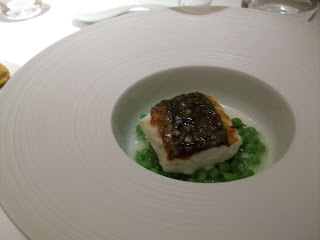
The Iberian suckling pig was crisp and succulent, and served with apples of two textures. Then we were served anise and fresh mint sorbet, to clear the palate. Of course, each course was accompanied by a glass of the appropriate Spanish wine, selected to perfectly compliment the flavours of each dish.
The first dessert was three variations on the orange; blood, navel and kumquat, served with "pop rocks" a childish and unexpected addition. The final course was chocolate olive oil ice cream with shattered bread and macadamias, a combination that sounds unlikely, but was delicious.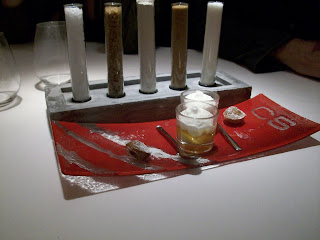 The coffee came with five different kinds of sugar, presented in test tubes (photo).
This dinner was most memorable, truly a sublime pleasure for all of the cinc sentit. We don't yet know if Barcelona has indeed surpassed Paris as the food Mecca, but we will let you know our findings after we get there.
We ordered the tasting menu to get a survey of what the restaurant had to offer, and found the quality and creativity of their food to be of the first rank. Our meal started with a layered
 shot of rock salt, warm maple syrup, chilled cream, and cava sabayon, a whipped custard made with sparkling wine. The shot is warm and cold, salty and sweet, and rich and creamy, all at the same time (photo). It is accompanied by a tapas of dry-fried marcona almonds and pimento-stuffed gordal olives.
Next came marinated mussels on green asparagus cream, followed by foie gras in a crisp pastry crust, with glazed leeks and caramelized sugar. The fourth course consisted of a large perfectly sauteed scallop, on a Jerusalem artichoke puree that had been seasoned with onion sauce. The second fish course was a piece of turbot filet on a bed of fresh young peas and pureed garlic shoots (photo).

The Iberian suckling pig was crisp and succulent, and served with apples of two textures. Then we were served anise and fresh mint sorbet, to clear the palate. Of course, each course was accompanied by a glass of the appropriate Spanish wine, selected to perfectly compliment the flavours of each dish.
The first dessert was three variations on the orange; blood, navel and kumquat, served with "pop rocks" a childish and unexpected addition. The final course was chocolate olive oil ice cream with shattered bread and macadamias, a combination that sounds unlikely, but was delicious.
 The coffee came with five different kinds of sugar, presented in test tubes (photo).
This dinner was most memorable, truly a sublime pleasure for all of the cinc sentit. We don't yet know if Barcelona has indeed surpassed Paris as the food Mecca, but we will let you know our findings after we get there.
Barcelona and Barca
We landed in Barcelona and rushed downtown to meet our friends, Alan Tate and Kerry McCuaig, at the apartment we were to share for the week. We had to hurry because our plane landed at 6:00 pm and we had tickets to see the legendary Barcelona soccer team at 8:00 pm. We dropped off our bags and hopped on the subway, heading for Camp Nou stadium.
The Barcelona soccer team has a long and rich history. It was founded in 1899, by a Swiss, John Gamper, as a democratic organization, and is still actually a club, now with over 100,000 members, who directly elect the team president and board of directors. Over the years Barca (pronounced Barsa) came to be regarded as a potent symbol of Catalan nationalism. Catalonia was an ancient kingdom, with its own language and culture, and Barcelona was its capital city. For many years the Catalan language was suppressed, along with its nacent union movement and the left-wing parties. In 1923, a visiting orchestra playing prior to a Barca match struck up the Spanish national anthem and was roundly booed and jeered by the fans in attendance. The dictatorial regime, embarrassed, expelled Gamper from the country in retaliation.
During the Spanish civil war 1936-39, Barcelona was a centre of resistance by left-wing and republican forces to the attempted military coup by the Fascist Generalissimo Franco. After the Franco forces defeated the troops of the legitimate elected government, they repressed all dissent. They executed thousands of innocent people, including the President of the Barca team, who was also a left-wing member of parliament.

Throughout the Franco years, the club was regarded as a symbol of hope by Barcelonans. They especially cheered any victory over Real Madrid, a team that was closely identified with the regime. When the team needed a new stadium in the 1950's, team supporters flocked to the team's offices, and lined up to donate money and to buy the bonds the team issued to finance the project. This effort resulted in Camp Nou which can hold 98,000 fans.
Today, the Catalan language is in daily use in Barcelona, rivalling Spanish (Castillian). There are TV stations and newspapers in Catalan, and the culture now thrives in the theatre, songs, and its own literature as well as being spoken as the daily language of many thousands of people. They all still love their team. The Barca team has its own TV channel, broadcasting 12 hours per day in Catalan.
 When we arrived at the stadium, we were treated to a league game against lightly regarded Recreativo de Huelba, which Barca won handily, 2-0. We had great seats at field level. After a very early first goal, they cruised through the rest of the first half, then turned it on in the second until they scored the insurance marker, despite a sometimes plucky defence and a couple of good scoring opportunities by the outmatched Recreativo.
It was an exciting beginning to our week in beautiful Barcelona.
The Barcelona soccer team has a long and rich history. It was founded in 1899, by a Swiss, John Gamper, as a democratic organization, and is still actually a club, now with over 100,000 members, who directly elect the team president and board of directors. Over the years Barca (pronounced Barsa) came to be regarded as a potent symbol of Catalan nationalism. Catalonia was an ancient kingdom, with its own language and culture, and Barcelona was its capital city. For many years the Catalan language was suppressed, along with its nacent union movement and the left-wing parties. In 1923, a visiting orchestra playing prior to a Barca match struck up the Spanish national anthem and was roundly booed and jeered by the fans in attendance. The dictatorial regime, embarrassed, expelled Gamper from the country in retaliation.
During the Spanish civil war 1936-39, Barcelona was a centre of resistance by left-wing and republican forces to the attempted military coup by the Fascist Generalissimo Franco. After the Franco forces defeated the troops of the legitimate elected government, they repressed all dissent. They executed thousands of innocent people, including the President of the Barca team, who was also a left-wing member of parliament.

Throughout the Franco years, the club was regarded as a symbol of hope by Barcelonans. They especially cheered any victory over Real Madrid, a team that was closely identified with the regime. When the team needed a new stadium in the 1950's, team supporters flocked to the team's offices, and lined up to donate money and to buy the bonds the team issued to finance the project. This effort resulted in Camp Nou which can hold 98,000 fans.
Today, the Catalan language is in daily use in Barcelona, rivalling Spanish (Castillian). There are TV stations and newspapers in Catalan, and the culture now thrives in the theatre, songs, and its own literature as well as being spoken as the daily language of many thousands of people. They all still love their team. The Barca team has its own TV channel, broadcasting 12 hours per day in Catalan.
 When we arrived at the stadium, we were treated to a league game against lightly regarded Recreativo de Huelba, which Barca won handily, 2-0. We had great seats at field level. After a very early first goal, they cruised through the rest of the first half, then turned it on in the second until they scored the insurance marker, despite a sometimes plucky defence and a couple of good scoring opportunities by the outmatched Recreativo.
It was an exciting beginning to our week in beautiful Barcelona.
Friday, April 10, 2009
Hangin' out in Valle Gran Rey
We docked in Valle Gran Rey (The Valley of the Great King), La Gomera last Friday, April 3. After the having seen the changes to Santa Cruz, I tried not to let my hopes get too high that it would be exactly as it was back in the day. It's not, of course, but it is still lovely, and the tourist development that has taken place is mostly small-scale, although there has been a lot of it. It hasn't ruined the beauty of the place, although the new roads, more cars, more hotels (low-rise, thankfully) and many more restaurants do encroach on it somewhat. There are many tourists, mostly German, but they are spread out enough so that the streets, shops, and restaurants are seldom crowded (except at nine pm one night, when we went out for a late dinner and had to go to three restaurants before we could find a table).
The great king's valley is about 2 kilometres wide at the sea shore, but narrows quickly further inland. There are three centres of houses, shops, and restaurants. Vueltas, at the extreme southern end, is the harbour where the ferry docks and a small fishing fleet moors its boats. A neighbourhood of houses, apartments, bars and shops sits immediately north of the docks at the base of the mountain (La Guerguenche) that defines the southern side of the valley. The sun doesn't rise over this mountain until after 10:30 am, so the mornings arrive very gently. Our apartment is in Vueltas.
 At the other (northern) end of a kilometre-long stretch of black (volcanic) sand beach is La Playa, another area of shops, restaurants, bars and hotels, with some local Canarians living there as well. This is a more happening area at night. There is a third built-up area, La Calera, (photo) about a kilometre inland from the beach, that is built up the base of the mountain (La Merica) that comprises the northern side of the valley. In all three areas many of the apartments are for rent to tourists, and most businesses cater to the tourists. Menus are in Spanish, German, and English.
 We were met at the ferry by Steve and Christine, the couple who own the apartment we are renting for the week. They walked us to the apartment, gave us a quick tour, then left us to explore this wonderful place on our own. The apartment has one bedroom and is of modest size, but it has glass patio doors comprising most of the west wall that open onto a balcony that has a fabulous view of the ocean, which is literally across the street. (photo)
We lost no time in starting to explore the valley, and have done a great deal of walking. Although there have been many changes and much construction since my last visit 39 years ago, some essential elements remain. The house I rented with friends 39 years ago is still there, in La Calera. (photo below) The lower floor is now a restaurant, where we had dinner one night. The food was good, home cooking. Barb had grilled tuna, I had grilled rabbit, done in the typical Canarian fashion, i.e with mojo verde (sauce made from hot green peppers, cumin, parsley and garlic pureed with olive oil and vinegar) and mojo colorado (sauce of hot red peppers, cumin, garlic, pimento, pureed with olive oil and vinegar), and wrinkly potatoes (new potatoes boiled in their skins in very salty water, then finished in the oven so the water leaves a slight salt crust on the potatoes when it dries). The waitress, like almost all the others we met, was a friendly German woman. She told us that one of the cooks now lives upstairs, in my former digs..
The bar on the beach where I used to go swimming, the Bar las Journadas, is still open and serving beer. Barb and I had lunch there. Maria, who is now over 80, owned it then and still owns it. She cooked our lunch, vegetable soup and fried tuna steak, just as she had 39 years ago. It's still delicious. Her son, who is 62, helps run the place these days. He came home to help out after spending many years in England. He owns a big red Harley with lots of chrome, and delights in blasting his way around the few streets that make up this small valley.
I walked to the Playa del Ingles, a beach at the extreme northern end of the valley that is somewhat secluded and cut off from the rest of the beaches. I had camped there for a few days when I first arrived years ago. I was a bit taken aback when I discovered that it is now a nude beach.
After all the activities of the previous seven weeks of touring, we were ready to relax, and this is the perfect spot to do just that. We walked, read novels, swam and ate good food. The sun shone every day, and the days were warm but the nights were cool. We even turned on the TV a couple of times, and found to our great amusement, a German sports channel that was broadcasting the men's world curling championships, live from Moncton. The week seemed to just slip by and before we knew it, it was time to get back on the ferry and return to Santa Cruz de Tenerife, on the way to our next stop, the fabulous city of Barcelona.
The great king's valley is about 2 kilometres wide at the sea shore, but narrows quickly further inland. There are three centres of houses, shops, and restaurants. Vueltas, at the extreme southern end, is the harbour where the ferry docks and a small fishing fleet moors its boats. A neighbourhood of houses, apartments, bars and shops sits immediately north of the docks at the base of the mountain (La Guerguenche) that defines the southern side of the valley. The sun doesn't rise over this mountain until after 10:30 am, so the mornings arrive very gently. Our apartment is in Vueltas.
 At the other (northern) end of a kilometre-long stretch of black (volcanic) sand beach is La Playa, another area of shops, restaurants, bars and hotels, with some local Canarians living there as well. This is a more happening area at night. There is a third built-up area, La Calera, (photo) about a kilometre inland from the beach, that is built up the base of the mountain (La Merica) that comprises the northern side of the valley. In all three areas many of the apartments are for rent to tourists, and most businesses cater to the tourists. Menus are in Spanish, German, and English.
 We were met at the ferry by Steve and Christine, the couple who own the apartment we are renting for the week. They walked us to the apartment, gave us a quick tour, then left us to explore this wonderful place on our own. The apartment has one bedroom and is of modest size, but it has glass patio doors comprising most of the west wall that open onto a balcony that has a fabulous view of the ocean, which is literally across the street. (photo)
We lost no time in starting to explore the valley, and have done a great deal of walking. Although there have been many changes and much construction since my last visit 39 years ago, some essential elements remain. The house I rented with friends 39 years ago is still there, in La Calera.
 (photo below) The lower floor is now a restaurant, where we had dinner one night. The food was good, home cooking. Barb had grilled tuna, I had grilled rabbit, done in the typical Canarian fashion, i.e with mojo verde (sauce made from hot green peppers, cumin, parsley and garlic pureed with olive oil and vinegar) and mojo colorado (sauce of hot red peppers, cumin, garlic, pimento, pureed with olive oil and vinegar), and wrinkly potatoes (new potatoes boiled in their skins in very salty water, then finished in the oven so the water leaves a slight salt crust on the potatoes when it dries). The waitress, like almost all the others we met, was a friendly German woman. She told us that one of the cooks now lives upstairs, in my former digs..
The bar on the beach where I used to go swimming, the Bar las Journadas, is still open and serving beer. Barb and I had lunch there. Maria, who is now over 80, owned it then and still owns it. She cooked our lunch, vegetable soup and fried tuna steak, just as she had 39 years ago. It's still delicious. Her son, who is 62, helps run the place these days. He came home to help out after spending many years in England. He owns a big red Harley with lots of chrome, and delights in blasting his way around the few streets that make up this small valley.
I walked to the Playa del Ingles, a beach at the extreme northern end of the valley that is somewhat secluded and cut off from the rest of the beaches. I had camped there for a few days when I first arrived years ago. I was a bit taken aback when I discovered that it is now a nude beach.
After all the activities of the previous seven weeks of touring, we were ready to relax, and this is the perfect spot to do just that. We walked, read novels, swam and ate good food. The sun shone every day, and the days were warm but the nights were cool. We even turned on the TV a couple of times, and found to our great amusement, a German sports channel that was broadcasting the men's world curling championships, live from Moncton. The week seemed to just slip by and before we knew it, it was time to get back on the ferry and return to Santa Cruz de Tenerife, on the way to our next stop, the fabulous city of Barcelona.
Subscribe to:
Posts (Atom)